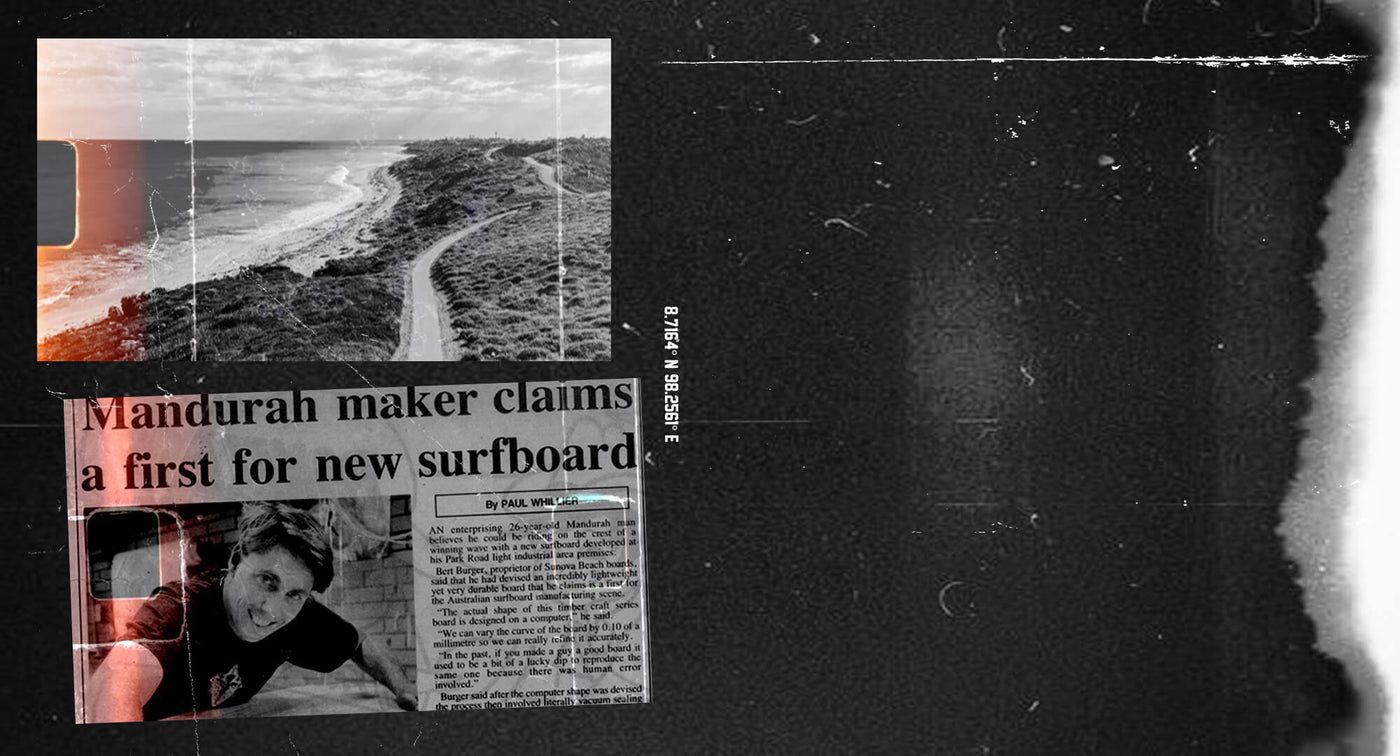
Sunova Surfboards - News

SHAPER OF THE YEAR 2007

BERT BURGER
BY NICK CARROL

It is a funny thing, really. Paranoia’s practically a way of life out there in Surfboard and a lot of it is fed by the frightening idea of the Giant Companies coming to Rape Surfing.

You know, these big-ass money machine corporations, from Asia or some such place, that’re gonna come roaring into town, selling popout kookmobiles left and right and undermining the brave little guy in his nice little factory, who only wants to maintain the Sacred Heritage of boardmaking. Or whatever.

So, here’s Bert Burger, from a little town called Rockingham, Western Australia. In the mid-1970s, modern surfing’s Core Soul decade, Bert grows up in a single parent household with no money.

The only thing he’s got in his favor is the beach; it’s a stone’s throw from his bedroom window. That and a mom and three uncles who happen to be avid surfers. Bert’s family is so poor that he has to innovate; he does his first shape job cutting grooves into the bottom of a polystyrene “coolite” board-at the age of seven.

When the Thruster appears in 1981, he can’t afford one, so he gets hold of an old singlefin, strips off the glass, re-shapes it, foils some fins out of Perspex and glasses the board back together using an old cotton bedsheet and a tin of resin he buys at the local hardware store. He’s 13.


A couple of years and quite a few boards later, he takes a school based intership at Town & Country’s West Oz factory. When the internship’s two weeks are up, Bert has a job. (He tells a lie about his age in order to get it.)

He learns to fix dings, sand surfboards, and make and foil fins. After a while Margaret River draws him, like it seems to draw most kid surfers from West Oz, and he ends up working for a company called Santosha Surfboards.

One day the head shaper, Colin Ladhams, comes back from a stint in the USA with two unsanded boards from a label called Ocean Rhythms. The boards are made from Styrofoam and epoxy resin. Col throws ’em at Bert and says, “Finish ‘em please.” Thus begins a journey.

Over the next decade and a half, inspired by those Ocean Rhythms and by a sailboard maker called Trevor Wright, Bert invents a way of building boards that nobody else has ever even tried. He takes foam, first polyurethane, then Styrofoam, and sandwiches it – deck, bottom and rails – with high density foam layers, thin wood veneers and epoxies, taking out the center stringer and compensating by loading up the rail with balsa offcuts.

He comes up with a board simultaneously lighter, quicker flexing and better looking than any surfboard, anywhere. His business expands, despite the fact that he’s charging almost twice as much for these boards as for the normal urethane variety.

Yet because it’s West Oz, an almost hermetically sealed surfing culture on the absolute other side of the planet from Southern California, Bert’s operation remains a near-complete secret from the wider surfing world.

He only grows so far, and no further. In 2002, after one too many business headaches, he decides that’s it, I’m taking a break. Bert goes back to a one-man band, builds a handful of boards each week, and considers his future.

Yet out there in the wider surfing world, things are shifting. Another sailboard maker, Randy French, manages to sell a critical mass of a new kind of surfboard, Surftech, effectively breaking the global urethane monopoly.

Suddenly, new kinds of surfboards begin to look like serious business propositions. In the midst of it, Queensland board maker Nev Hyman parts ways with one business enterprise and begins looking for another.

Nev is unbelievably energetic and fired-up about the future. He knows people like Matthew Perrin, ex-CEO of Billabong, who sold his shares in the company for $66 million a year or so ago, and Matthew’s savvy former general manager Dougall Walker.

Nev and his partners come knocking on Bert Burger’s door. And it all happens just in time for Gordon Clark to wake up one morning and send Surfboardland a faxed letter saying he was junking his polyurethane juggernaut and going home. It’s a weird, weird world.

The Giant Company that Raped Surfing turned out to be the one that’d been there all along. Now it’s gone, and the door’s open for every kind of new idea anyone can think of, make and sell. The money machine is funding the little guy and his radical alternative, and the world might just be beating a path to his door. Welcome to Burgerworld.


SURFING MAGAZINE: YOU STARTED SURFING VERY YOUNG. WHAT PART OF YOU CONNECTED SO EARLY WITH SURFBOARD BUILDING? BERT BURGER:

Well, there was always this real love for the ocean. But as far as board building, I don’t know. It’s funny. When I was 27 years old I met my dad for the first time.

He left us when I was about two years old and I’d never met him; I didn’t have any memories of him. I finally meet him when I am 27 years of age and he starts telling me about our family history and where our family came from in Holland.

My grandfather had had a business that was passed down to him over a 400 year period from father to son. My father didn’t take on the business because he decided to travel, and pissed off to Australia, so my grandfather decided to sell it. My father was devastated because he was really looking forward to taking on that business one day.

The business was wooden boat building and engineering. And when my dad met me, he freaked. Because here I am in Australia, never had any connection with my family at all, and I’ve got a business building wooden surfboards.

Of all the things that you could do with your life, I ended up doing something my family had been doing for hundreds of years. I dunno. I think there might be a bit of genetic recall or genetic predisposition there somewhere.

FOR YOU, AS YOU DESCRIBED IT, IT WAS ALL ABOUT PERFORMANCE, HOW TO FIND NEW PERFORMANCE. CAN YOU DESCRIBE WHAT YOU WERE LOOKING FOR AS YOU WENT DOWN THE PATH OF EPOXY AND STYRENE AND WOOD VENEERS?  

Well, because I had been exposed to those epoxy boards, it was, “Wow, there’s a difference” I suppose that gave me the concept that if the materials are different, then the ride’s gonna be different.

I had that in the back of my mind. It got to the stage when I was in my early 20s and I was a board consumer – I’d have a board two days and I’d snap it. If I had a board longer than three months, I was doing well. So that was one side of it; I thought I wouldn’t mind something stronge

But there was also the idea of what can I do to make ‘em better. I just felt I was chasing my tail around with board design.

I made my boards as light as I possibly could, that was definitely an element in performance: if they were light, you could throw ‘em round, you got control, and so I knew that.

And from those epoxy boards, I knew they were REALLY light. That was probably the first motivation, just to bring the weight down. And that got me back to the idea that you could change performance through changing materials.

I would make boards identical to my urethane board, and depending on the structure I was using, some would go waaay better and some would go waaay worse.

The original rule was performance through weight, then it became performance through what the materials were doing. It didn’t happen overnight. It’s still changing all the time, fresh concepts creeping in. It’s good. One thing I love about making boards is that you never know everything.


YOU TOLD ME THAT YOU DIDN'T BELIEVE IN THE CURVE ANYMORE DESCRIBE WHAT YOU MEAN BY THAT.

Well, in a sense, most shapers trust a curve. There are certain curves they'll use in a board and certain curves have certain performance patterns.

A long, straight outline will give you a long, straight turn. If you have a short, wide board and a little more curve, you'll have a tighter turning board.

So the curves in the board dictate its turning characteristics.But that's only related to the materials it's made out of. If you have two boards made out of the same materials, and they have different curves, the curves are gonna determine how the board goes.

But if you have two boards made of different materials, the curves no longer have as big an impact. A lot of guys who build traditional boards, they know certain curves and they really don't want to let ‘em go.

But the different materials mean that the curves can't be trusted anymore. You've got to look at what it's made of.

SO, CURVE IS MORE ARBITRARY THAN IT SEEMS.

Yeah. It's all related to the construction. You can only relate the curve in one board to the curve in another if it's made of exactly the same stuff.

HOW DO YOU WORK THROUGH THAT? AS YOUR FIREWIRE IDEA HAS BECOME EXPOSED TO THE PRO LEVEL OF SURFING, I SUSPECT SOME OF THAT PRO FEEDBACK MIGHT HAVE CHALLENGED YOUR OWN DESIGN IDEAS. IS THAT THE CASE?

To be perfectly honest, I'm learning to be really patient. I've had to teach them, in a sense, to get a grasp of the differences.

Even with Taj and others, like, those guys are very good surfers and they've been around surfboards for a very long time, so they've got this mental image of the perfect board.

And if it's not that perfect board, they don't even ride it. They've got that much experience of riding so many different boards, their window is very narrow.

To give them anything different or to even suggest it, they'll screw their face up. Taj ended up getting exact duplicates of some of his favorite boards, and to me, I didn't really see the point in that, but what it has done is that it at least gives these guys a feeling for the technology.

It's like what I'd done at first, making one board from one thing and one board from another and going, “Hey, these boards actually FEEL DIFFERENT.”

And so for those guys now, I'd expect they'd come back and say, “Yeah, I can feel the difference between constructions, and yeah, let's change the next one.”

It's start. I'd rather they find out for themselves, I suppose. If they make that decision themselves, they own it; they feel a part of it. And with Nev, as well.

Nev's a really knowledgeable shaper and we disagree on so much stuff. It's been really fun working with him. He's picked up on so much in such a short time.

Nev told me a while ago, “You've just gotta let me work through this myself and figure it out, go through the logical steps of understanding the technology.”And so will guys like Taj. They'll come back and tweak it here and there and make it right for themselves.

DO YOU THINK THERE’S A DIFFERENCE BETWEEN SOMEBODY WHO CHOOSES TO EXPERIMENT? BETWEEN THE TRADITIONALIST AND THE EXPERIMENTER?

Man, absolutely. Because the guy who experiments, he’s in it for the love. In all ways. There’s no money in experimenting.

There’s no payday. If you bang out a bunch of traditional boards in a week, you get paid by the end of the week.

If you experiment, you aren’t getting paid. So you’ve got to be in it for the love. I’ve noticed that with anybody I’ve ever met in this business, people who are searching or trying alternatives, they’re doing it because there’s a passion there; they’re doing it because they love it and they’re searching for something. They’re definitely not doing it for the money.

YOU NEARLY GAVE UP ON ALL THIS.

I’ll always build surfboards. I’ll always do that ‘cause I love it. But I suppose what I gave up on was the whole kind of industry way: make lots of boards, get more retailers, get more team surfers, that whole thing.

I was just worn out with it. I’d been making boards under my own label from 1988 to 2003 and it was a 15 year slog. And it progressed and went forward, but it grew beyond one person.

And because I was doing something different I had to train people a lot more, compared to a regular boardbuilding company. And having soooo many knockers! It gets painful after a while.

You’ve got a whole industry that doesn’t wanna see you succeed. There was a lot of propaganda and a lot of negative vibes and I think it just wore me down. I thought, “I’ll have a little factory and make a few boards a week and be content with that.”

Just opt out of the business side but keep that passion and love for building boards which was what I’d really enjoyed doing anyway.


ARE YOU SURPRISED NOW AT FIREWIRE’S ACCEPTANCE, HOW FAST IT APPEARS TO HAVE HAPPENED? AND IF SO, IS THERE A SENSE OF VINDICATION AT THE PATH YOU’VE CHOSEN WITH YOUR BOARDBUILDING?

Yeah, I suppose there is to a degree. I remember years ago, crew used to come in and look at the boards, and say, “Oh well, we’ll wait and see.” And enough time has gone by now for people to have waited and seen, and the boards have stood up to the test of time.

But I still think it’s a wait and see thing. I think the test for anything to really be validated is whether other people make it or not.

Like with the Thruster. Simon brought the Thruster to the fore then it was really all the other guys that built and rode Thrusters that validated it.

With this thing, if it’s that good, in time you’ll see a bit of a shift, you’ll see more people making boards like this and I think that would validate it. I think we still have to wait and see.

HOW HE GOT THERE :
HERE’S HOW, OVER A DECADE, BERT TRAVELED FROM NORMAL BOARD TO FIREWIRE

STEP 1        A normal polyurethane blank with a vacuum-glued timber deck. “It was basically a normal board with a layer of timber veneer vacuum-formed onto the deck. I made them for myself super light, using a blank that was considered disposable, but the decks held up and didn’t self-destruct like my normal boards. They went well, but when I copied them without the wood, something was missing again.”

STEP 2        Timber veneer on top and bottom of a styrofoam blank. The result lacked drive and momentum, according to Bert. “I felt they hung up at the top badly. I was making epoxy sandwich boards too, but the timber veneers were the best of a bad bunch, so I concentrated my efforts there.”

STEP 3         Foam and wood along the rail. Bert felt the boards were over flexing, so he decided to strengthen the rail line, using rail offcuts from a standard PU blank to sandwich an extra wood stringer between the two foams, about an inch in from the outline curve. Now the board had all its projection and then some, but it felt too stiff.

STEP 4         Eliminate the center stringer. How to bring some flex back in?  Next board around, he just left out the wood down the middle. In Bert’s words, “Wow!”

STEP 5         Eliminate the rail foam. Within six months he’d cast off the PU foam rail layer and turned the rail into pure balsa. Thus was born the “parabolic rail stringer,” resulting in the Firewire’s characteristic twangy flex. “This one was magic. I lent it to a few guys and everyone freaked. Everyone who rode it was doing stuff they had never done on a board before.”

BACK